

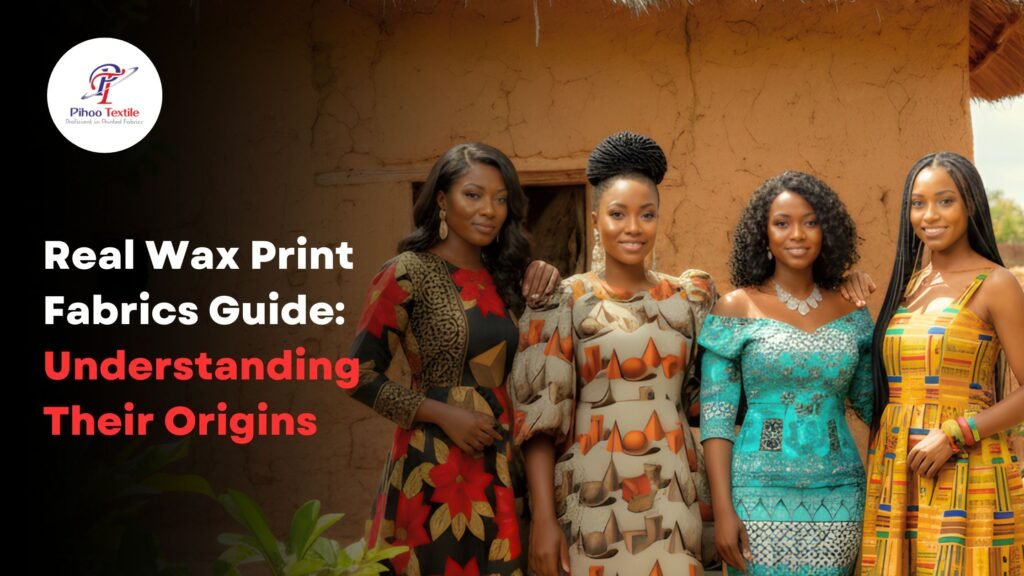
Real Wax Print Fabrics Guide: Understanding Their Origins
Introduction Most buyers assume “African wax print” originates in Africa. It doesn’t—and understanding why matters more than the misconception itself. The fabric has a complex three-continent origin story that directly explains what separates authentic real wax prints from cheap imitations flooding the market today. Sellers who don’t understand this history can’t reliably authenticate what they’re selling, which is why counterfeit wax prints remain so common. Real wax print’s double-sided printing, characteristic crackling, and 100% cotton construction aren’t random quality markers—they’re direct products of a specific manufacturing process developed over 150 years ago. This guide traces that full journey: Indonesian batik origins, Dutch mechanization and the accidental West African market, the cultural transformation that made wax print distinctly African, production shifts across continents, the manufacturing process that creates authentic fabric, and exactly what separates real wax from imitation. Understanding the origin reveals why authentic fabric behaves so differently from synthetic substitutes. Indonesian Batik Origins Traditional wax-resist dyeing originated in Java, Indonesia, where artisans applied molten wax to cotton cloth by hand using copper stamps or pen-like tools. The waxed areas resisted dye penetration during immersion, creating patterns through color contrast. A single complex piece required weeks of labor—multiple wax applications, dye baths, and wax removal cycles for each color layer. The resulting textiles carried significant cultural and social status in Indonesian society. Specific patterns indicated rank, occasion, and community membership. Dutch Mechanization Dutch colonial administrators in the East Indies saw commercial potential in batik and attempted to industrialize the process during the mid-1800s. They developed engraved copper rollers that stamped wax patterns onto both fabric sides simultaneously, replacing the hand-application process. The mechanized system produced cloth in days rather than weeks at dramatically lower cost. Dutch manufacturers expected to dominate the Indonesian market with affordable mass-produced batik. Indonesian consumers rejected it completely. The copper roller process caused the wax coating to crack during dyeing—creating irregular vein patterns where dye seeped through. Indonesian buyers considered this crackling a manufacturing defect rather than a feature. The Dutch faced warehouses of unsellable fabric and a failed market strategy. West African Adoption Two routes brought Dutch wax prints to West Africa in the 1880s. Trading ships carried the rejected fabric as speculative cargo to West African ports. Simultaneously, West African soldiers who had served in the Dutch East Indies—known as Belanda Hitam—brought pieces home as gifts for family. West African communities responded entirely differently than Indonesians. The crackling effect read as proof of authentic wax-resist processing rather than a production flaw. The bold color contrasts and geometric patterns aligned with existing West African aesthetic preferences. European manufacturers pivoted their entire production strategy toward West Africa within a decade. The commercial failure in Southeast Asia became a commercial success in West Africa through pure accident. That historical accident created what we now call “African wax print”. Cultural Transformation West Africans didn’t simply adopt Dutch wax prints—they completely remade them. Communities commissioned custom designs incorporating local symbols, proverbs, and culturally specific motifs. Patterns acquired names tied to local events, relationships, and social commentary. The fabric became a communication medium. Women used specific prints to express sentiment without direct speech—a function that had no parallel in Indonesian or Dutch use. This embedded meaning is why wax print patterns often carry names rather than just design codes: “jealous girlfriend,” “television,” “iron”—each name encoding a social reference visible to those who know the context. Production Evolution Manufacturing geography shifted repeatedly across the 20th century: This shift explains the quality range in today’s market. Chinese mass production generates both authentic wax-resist prints and cheap surface-printed imitations sold under identical marketing. How Real Wax Gets Made The authentic wax-resist process creates the markers buyers use for authentication: This multi-step process creates dye penetration through the entire fabric thickness—which is why authentic wax print shows near-identical color on both sides. Real vs Imitation Wax The origin story explains every authentication marker precisely: The most counterintuitive quality signal: if a wax print looks too perfect—no crackling, flawless color uniformity, identical pattern precision across the entire surface—it’s almost certainly not real wax. Wax Prints in Contemporary Fashion Wax prints moved from West African ceremonial and everyday wear to global fashion runways over the past two decades. International designers began incorporating the fabric into collections, and African diaspora communities drove wider visibility through social media and cultural pride movements. The “Africa’s pride or colonial legacy?” debate continues—the BBC framed it directly in 2018. Most scholars and wearers have settled on a pragmatic position: the origin is colonial, the cultural transformation is genuinely African, and both facts can coexist without resolving into a single clean narrative. FAQs Does manufacturing origin affect fabric authenticity?No. Authentic wax-resist processing can happen in China, the Netherlands, or anywhere else. What determines authenticity is the manufacturing process—wax application, dye immersion, crackle formation—not the country where production occurs. A Chinese-made real wax print using proper wax-resist processing is authentic. A Nigerian-made surface-printed imitation is not. The process matters, not the geography. Why do West Africans consider crackling desirable when Indonesians considered it a defect?Different aesthetic frameworks evaluate the same feature differently. Indonesian batik buyers valued controlled precision—hand application created intentional patterns without accidental variation. West African buyers interpreted crackling as visible evidence of wax-resist processing, which functioned as authentication. Once crackling became associated with quality rather than failure, it became a sought-after characteristic rather than a problem to eliminate. How did pattern names develop and what do they mean?West African communities assigned names to wax print patterns based on visual resemblance, social events, or cultural references at the time the pattern was introduced. “Television” was named when the technology appeared. “Jealous girlfriend” describes a pattern resembling eyes watching from multiple angles. These names vary by country and region—the same pattern can carry different names in Ghana versus Nigeria. The naming practice transformed commercial fabric into culturally embedded objects. Are African-manufactured wax prints better than Chinese-manufactured ones?Not automatically. Quality depends on whether the manufacturer uses authentic wax-resist processing regardless of location. African factories